Showing posts with label France. Show all posts

Tuesday, January 20, 2009

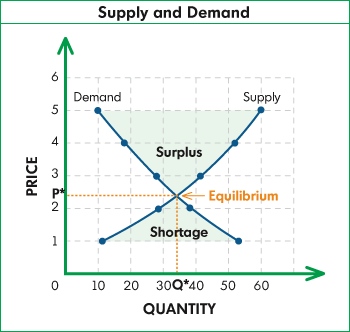
France Denies the Law of Supply and Demand


Well, just when I was starting to like the French again, they go and try to void the law of supply and demand. More specifically, as reported in the Wall Street Journal, Luc Chatel, the junior industry minister, wants French automakers Renault and Peugeot Citroen to promise not close factories in return for a government bailout.

While I am all in favor of setting conditions for government money, those conditions shouldn't place the company in an uncompetitive situation. For if the company is uncompetitive, the taxpayer is chasing good money after bad. Cheap? No. 100% Free. Trade stocks for free on Zecco.com. The Free Trading Community. www.zecco.com

Consider that labor, in general, is demanded by manufacturers. Labor is then segmented by its market and skill. Different countries have different quantities of skilled labor at different prices. We have all seen that with BMW plants in South Carolina and Hyundai plants in Alabama. Well, Turkey is much like Alabama, relative to skilled labor.

For the French automakers to survive, they need to find cheaper labor than 35 hour a week union members who take 6 weeks off and go on strike when the wine in the company cafeteria doesn't pair properly with the foie gras. Let's also not forget the smoke breaks.

However, M. Chatel thinks that by forcing the factories to stay open and carry excess capacity (15% for Renault per Credit Suisse), that will make things all better. WRONG! Let's consider the US plan which is to provide badly needed capital in return for a stake in the automotive companies. The governement is working to set benchmarks to streamline production, control costs, etc., though isn't calling for make work jobs, at least not yet. Come on, Obama was just inaugurated and the Congress hasn't finished all of the Inaugural ball debauchery. Compare Auto Insurance Quotes and Save!

In short, demand for cars in France is down with French labor being some of the most expensive in Europe. To stabilize their automotive industry, the automakers need to reduce costs, and lower cost labor may be the key. In the meantime, M. Chatel should go back and take a basic economics course and let that be his basis for recommendations, and not politics.

Click Here to Protect your Identity with TrustedID

Friday, October 24, 2008

A Global Nuclear Renaissance

An article in the 24 October 2008 print edition of the Wall Street Journal (B2) reports that France's Areva SA and Northrop Grumman are forming a joint venture to build heavy equipment for the nuclear power industry, as well as an engineering center in Newport News, VA.

According to a joint press release on 23 October:

The 300,000 square-foot facility represents a significant investment of more than $360 million in the U.S. commercial nuclear and manufacturing industries and will bring more than 500 skilled hourly and salaried jobs to the Commonwealth of Virginia. AREVA Newport News will be the first full-scale manufacturing facility dedicated to supply heavy components, such as reactor vessels, steam generators and pressurizers to the U.S. nuclear energy industry.


What the casual reader should know is the that the Newport News facility is one of the world's largest shipyards, and only one capable of building a Nimitz-class nuclear aircraft carrier. In short, it is a gigantic heavy industry site with highly-skilled labor.

This story is relevant to this blog not only because it follows the path of several previous articles:
"A Nuclear Renaissance in Germany?", "Nuclear, French Style", "Nuclear, India Style", "Nuclear, America Style", and "Build Wind, Drop Nuclear - Germany Loses its Mind" but also because nuclear power is one of the "greenest" and most reliable source of energy on the planet. This joint venture is also a shot in the arm of US heavy manufacturing, as the predicted market for its products is $100 billion.

Nuclear power is good for the US and those nations who are responsible. Let's hear it for Areva and Northrop Grumman for expanding the opportunity for clean and reliable power to the rest of the world.

Monday, August 18, 2008

Nuclear, French Style

Ah, the French. While I love to poke fun at them and their, um, French ways, I have to give them credit for their successful nuclear power program. There, I said it. The French do something right that isn't silly.

The New York Times ran a piece titled, "France Reaffirms Its Faith in Future of Nuclear Power" on August 17, 2008. In it, the explain how France got its act together, starting in the late 1950s, to be as close to energy independent as possible. The article states, "Nuclear power provides 77 percent of France’s electricity, according to the government, and relatively few public doubts are expressed in a country with little coal, oil or natural gas." Certainly, this has helped smooth out many economic bumps experienced by those countries without such an aggressive nuclear policy. Additionally, think of how clean the air is without all of those coal plants?

Did I mention that nuclear power is clean, reliable, and cost effective? Here is where France really makes nuclear the best option: "He (senior aide to Jean-Louis Borloo, the minister of ecology, sustainable development and planning) said that France’s choice for a “closed fuel cycle” — reprocessing used nuclear fuel to recover plutonium made in the reactors so it can be reused — was safer." Too bad Jimmy Carter banned fuel reprocessing in the US. Spent fuel from first use has about 95% of its active ingredient left. Hey, recycling, what an idea!

Finally, the French discovered that having a successful power program is great for their economy. In some towns, the 60-year life cycle of a nuclear power plant, "...we have economic activity for two generations.”

Monday, July 28, 2008

Germany Loses its Mind-Follow Up

First, thank you to all my readers. I hope you are finding the posts worthwhile and occasionally humorous. I pride myself on the research that I do for each post, as well as my professional experience and Masters-level education. And yes, nuclear energy is safe, very safe.

I would like to post a comment to one of my posts on Germany's decision to decommission nuclear plants in favor of wind farms. Again, thank you for your comments.
Anonymous said...

I hope nobody reads your ramblings, mate. You clearly ignore the horrors and suffering that Chernobyl caused and still continues to cause to Eastern Europe. Nuclear energy is not safe, period. Anyone who says so is ignoring the number of accidents around the world that get reported 2-years after they happened -- or never if they can conceal it (Russia?).

We -- Germans -- simply do not trust the people working in nuclear power plants. The technology may be alright, but the human beings inside are no computers, we all make mistakes. Chernobyl was no technical issue, but a series of very unlikely human errors. As long as we are in control, nuclear power is not safe. OTOH I wouldn't even think about giving a computer total control over such a thing.

And please, stop bragging about your superior common sense, when it sounds more like some down-home-hokum. You clearly have little facts at your hands as you continue to accuse every other person on this planet to have none.

Look at some pictures of the people dying in Chernobyl and read about their stories and then remember that it was a human error that can and will happen again. Maybe this could teach you some compassion.

And while we're at it, just buy a bike and use it instead of a car and choose home appliances by their energy usage -- the German build ones are pretty good at this, maybe then you can understand that our environment is pretty dear to us.

So, if you research nuclear power generation globally, you will find that the Russians failed to build a secondary containment unit of reinforced concrete, which is standard for ALL Western nuclear plants. If they had done that, the deaths and devastation wouldn't have occurred.
The French and the US have managed to run nuclear plants without fatalities for over 30 years. Guess what, that's a lot safer than flying in a plane or riding a bicycle!! Human error is real. However, with proper planning and risk management, nuclear power generation remains the cleanest and safest, without exception.

We pray for the souls of the dead and injured from Chernobyl, but also place the responsibility where it belongs, squarely on the shoulders of the haphazard Russian builders.

Monday, July 21, 2008

Nuclear, American Style

I have written about nuclear power on two occasions, "Build Wind, Drop Nuclear? Germany Loses its Mind!" and "Nuclear, Silver Bullet or Money Pit." While I generally have a positive outlook on nuclear power, I must agree with William Tucker, author of "Terrestrial Energy: How Nuclear Power Can Lead the Green Revolution and End America's Long Energy Odyssey," which is due out in September, as to how the US can do it better.

In the 7-12-2008 edition of The Wall Street Journal, Mr. Tucker writes an editorial titled, "Let's Have Some Love for Nuclear Power." He outlines the strengths and weaknesses of the current energy situation in the US, and points out how coal, while abundant and efficient, creates significant amounts of CO2 and other pollutants. He also clearly spells out the costs and inefficiencies of solar and wind.

What makes Mr. Tucker's discussion unique is that he points out the need to allow investors to decide whether to invest in nuclear, and not just rely on subsidies. As I mentioned in my "Silver Bullet" post, some companies have decided not to pursue new nuclear plants. For nuclear to be successful, a stable, regulatory environment must be in place, as well as re-allowing the recycling of spent nuclear fuel.

Government, yes I said government, can help out in both instances. Regarding regulation, the US government has improved and streamlined the process for building new plants. Now all it needs to do is overturn that genius president, Jimmy Carter's ban in fuel recycling. Tucker gives an easy to understand example. France, which has produced 80% of its electricity needs from nuclear over the past 30 years, recycles its spent fuel. The waste product fits in one small underground room. Imagine if the existing spent fuel could be recycled for fuel, as well as industrial and medical purposes, not only would nuclear power be even less costly, but actual waste would be reduced.

Let's here it for more clean nuclear power, as well as nuclear recycling!

Tuesday, July 1, 2008

Nuclear, Silver Bullet or Money Pit

When discussing the "energy crisis," one of main issues is electricity, including its generation and distribution. In the US, electricity is mainly generated by burning fossil fuels, however, nuclear power generates about 20% of nations electricity, with hydroelectric, and to a much smaller degree wind and solar rounding out the list (numbers, source EPA).

When considering what is the most efficient as well as "best" for the environment, nuclear seems to be a pretty good option. Its day to day generation of electricity doesn't produce any green house gases or other pollutants to global warming adherents fear. Were that not enough, the French produce 80% of their electricity through nuclear power. So why not more here in the US? Cheap? No. 100% Free. Trade stocks for free on Zecco.com. The Free Trading Community. www.zecco.com

In the July 7, 2008 print edition of "Business Week," there is an article titled, "Nuclear's Tangled Economics," (which is the source of all quotations in this post). It highlights presidential candidate John McCain's desire to have 100 new nuclear power plants. The article also highlights that current estimates put the cost at new plants at about $7 billion dollars. While that number is expected to grow as the cost of materials to build the plants grow, the question is whether it makes sense for power companies to build them.

One the first issues any such project is going to contend with is the cost of regulation. Fortunately, the US has standards for building new plants, as well as more efficient regulation. However, some power companies have decided to drop their projects. Most notably, MidAmerican Energy Holdings, "... a gas and electric utility owned by Warren Buffet's Berkshire Hathaway, shelved its own nuke plan earlier this year, saying it no longer made economic sense." Protect your Medical Identity with TrustedID. $1,000,000 Warranty & Great Customer Service

While Berkshire Hathaway shareholders should be grateful for the careful financial management of the company, they may also consider that NRG Energy, Dominion Resources, Duke Energy, and "...six other companies have already leaped to file applications to construct and operate new plants largely because of incentives Congress has put in place." The incentives are not just tax credits, but also $18.5 billion in loan guarantees. Considering the status of the credit markets, the loan guarantees can make all of the difference. eFax Annual Subscription

While nuclear energy is clearly one the best, proven, and clean technologies for electricity generation, it isn't without commercial risk. Each power company is going to have to review the risks, their capital positions, and the economic climate to determine is building a new, nuclear power plant is right for the share holders.

Find $100K+ Technology Jobs
Peace and Freedom for Iran!
Respect Life, Defend the Weakest Among Us!

ShareThis